
Top take aways from AI for Publishers Exchange

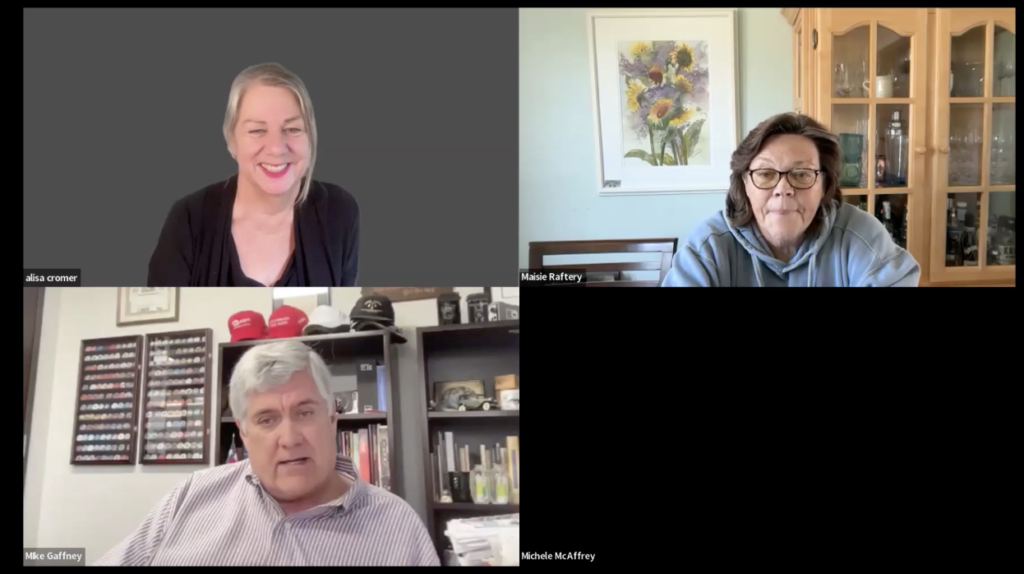
Most publishers at the NichePublisher’s recent AI For Publishers virtual roundtable have jumped headfirst into projects — powering sales strategies, vibe-coding websites for a library of domain names, and mapping workflows in preparation to automate and more.
The AI tools in the spotlight for this group were Replit for vibe coding, Claude Cowork as a virtual assistant, Opus Clips for video reels, and Chat GPT for quick logos and strategic plans.
Here are use cases shared:
1. Vibe-coding gets a moment
It was serious conversation we’ve had about vibe coding at a publisher roundtable — in this case, using Replit’s no-code tool – also mentioned in Tony Robbins new AI course, according to Maisie Raftery, publisher of Natural Awakening, who took the class (she said it was great).
NPB originally heard about Replit from Mike Gaffney, CEO of Pixelworks. Gaffney sold seven magazines a few years ago but kept more than 1,000 domain names. Since then, he’s focused on sales of “exact match” names in the portfolio, along with building and monetizing a few hundred of the best ones — think SanAntonioLawyers.com. He started out building on WordPress, but now only builds on Replit – 200 websites so far – and is in the process of shifting the rest of the WP sites over – about 150 -the Replit as well.
Using Replit, he can build a website – typically a directory – himself in about two hours per site, or 10 minutes to copy a formula that worked – no coding required. About 150 websites are now published on Replit.
He still uses ChatGPT to map out business plans, pricing based on what competitors are doing, and sometimes even the prompts he gives to Replit when building a new website.
Replit + Print
Gaffney also gave concerns about his business formula: It may soon become too easy to build content like directories, since anyone can do it, eventually resulting in homogenized competing websites, primarily differentiated by the brand.
So today, while excited by the opportunity to scale, he misses the branding that comes with print magazines and is exploring partnerships with print media that want to expand a brand footprint using exact-match domains.
2. Vibe coding using existing content
Alisa Cromer, NichePublisher.biz, shared a few of her recent builds on Replit as well. Rather than populating new domains, her aim is to deepen relationships with members.
To support participants at the AI for Publishers roundtable, for example, she created a new AI for Publishers App, built using only content on the NichePublisher website and its directory, MediaTech Referral Network.
There is a simple search bar on the NichePublisher.biz website, but it didn’t feel as useful as it should be for identifying the best AI opportunities.
The app, completed without a developer in about three hours, has an AI-powered search bar, along with five categories: Sales, Content, Data, Admin, and Coding. Publishers get a summary of a real question, such as “How do I convince my editor?” along with a list of use cases from the website and tools used.
Clicking on the tool also allows them to connect with the publisher who referred it. Users can save each use case to a roadmap, and score them on three criteria: Moves Real Dollars, Fast to implement, and Improves Content.
Today, the tool is published on Replit, and the plan is to move it behind a link on the website URL with full original branding.
To update the site, she can go into the same project on Replit, add new use cases and tools, and republish. The new version will update on the live site, no developer required.
3. Using Replit for additional content
When Cromer got a few questions from publishers about how to sell their company, she decided to build an app that tracked media mergers and acquisitions. Created in hours, the app gives a realistic understanding of potential buyers and what they are interested in. To build the app, she used a list of likely sources, such as MediaPost and media brokers. The information is extracted from the web, but links to sources. Weekly updates must be approved by an editor before publication.
4. Pressable hosting now incorporates AI
Pressable, a WordPress-specific hosting platform, now connects to AI — a quiet but important signal that AI tools are no longer just sitting on top of the workflow. They’re moving into the foundation, where developers can use them to update code snippets and other projects more efficiently.
Charlotte Moore, publisher of MyActiveChild, gave accolades to Pressable for support services during a recent complex hosting transition and said she is looking forward to an AI-enabled future.
5. OpusClip “shockingly good” at repurposing video into reels
Angie Thompson of Fishing Tackle Retailer reported that OpusClip is an easy, quick way to turn existing video into shareable reels. Her words for it: “shockingly good.”
For publishers already creating video but not getting distribution mileage from it, this one is an easy option. The user uploads any video, and OpusClip intuitively turns the most interesting information into a series of short reels that can be socially shared.
6. Claude Cowork as sales assistant
Thompson’s use Claude Cowork to empower the sales team by generating personalized sales briefs for each client call — drawing on both internal company knowledge and outside research — with talking points, recommendations, and a draft proposal, all in one document.
“Sales people love it,” she said. “It gives them confidence to make the phone call instead of sending an email.”
Like Claude Sonnet and Claude Code, Claude Cowork has its own projects but is unique in that once the app is downloaded on a desktop, it connects with the user’s email, docs, and calendar.
Once, Thompson said she used voice commands to draft a sales schedule for an upcoming conference, with talking points for each prospect, while driving to the event. David Shiller, publisher of LightNow, has done the same thing.
Thompson also uses Claude CoWork integrations with her email and calendar as a personal assistant.
7. Mapping the workflow
| Maisie Raftery, publisher of Great Awakenings Boston, said that buying a statewide distribution business in Rhode Island meant she needed to tap into AI to achieve a higher level of efficiency, in short, to recreate her own job position.
She is starting by simply mapping out the process in her business — where people find her, what happens next, and where the friction is. She is still in the process. |
Mike Gaffney, publisher of PixelWorks, weighed in that asking the “AI thing” for suggestions about what to automate speeds up the process by finding potential workflow paths you may not have thought about.
Bonus: Why Be Nice to AI?
Not even half joking here. More than one publisher noted that being nice to AI is a good idea.’We all get frustrated,” talking to the ‘AI thing,” Gaffney said. But unleashing on an AI assistant may cause it to “unlearn things” you already taught in an attempt to please you. “It’s like a puppy,” he said
Raftery agreed, “I got into such a fight with it last night. Why didn’t you say that three hours ago?”
She has been wondering if that was such a good idea.
And it’s a wrap!
Many thanks to all the publishers who shared. We can’t wait to see what they between now and the next AI exchange later this year.


