
The FOMO Playbook for Publishers

Creating fewer, more expensive products and selling out can stabilize the business and make more money in the long run, some publishers have shown, turning otherwise lagging products into cash cows.
This report shows how they did it: Raising value by limiting inventory, gating categories, turning open-ended sales into urgent decisions, building in higher-value content services, and requiring annual contracts with first right of refusal.
Limiting inventory is so effective because, when done well, the advertisers get an exciting and bigger share of the audience and/or prominent placement, extra content, and distribution.
When Central Florida Media Group shifted to this model, after hiring Nearview Media Consulting, website revenues finally popped, according ot 2026 Niche Revenue Survey. This report explores the eight tactics we found when interviewing publishers.
Build your own plan with the FOMO creation calculator.
1. Limit inventory to a few well-defined larger tiers + industry exclusivity
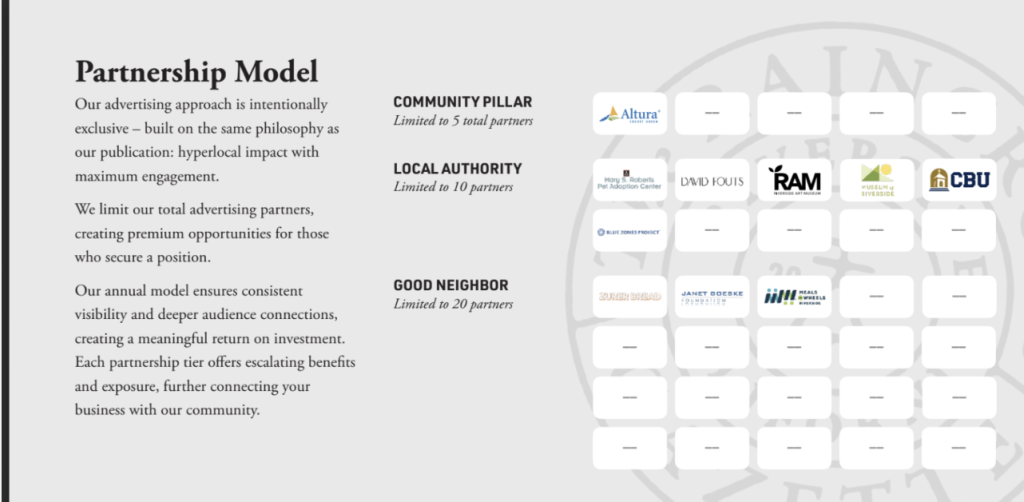
To sell out its newsletter-first model at pricing levels to sustain the company, Raincross Gazette, a community media company in Riverside, Ca., capped each partnership tier, offering industry exclusivity for the top two. With a small number of partnerships avialable, advertisers had a reason to act now rather than wait. Content marketing added value supporting the pricing.
Founder Justin Pardee runs the four-year-old, 10,000-subscriber newsletter, entirely on these three tiers (above), now also including web advertising in the tiers.
Community Pillar — $30,000/year, capped at 5 advertisers, industry exclusivity plus monthly sponsored stories
Local Authority — $10,000/year, capped at 10 advertisers, industry exclusivity
Good Neighbor — $5,000/year, capped at 20 advertisers, no exclusivity

Don’t forget to give your tiers exciting names that match your niche. Pardee did a great job with this, and newsletter revenue grew from $17,000 in 2022 to $225,000 in 2024, with 2025 in the range of $375,000+.
2. High Value Premium Ads
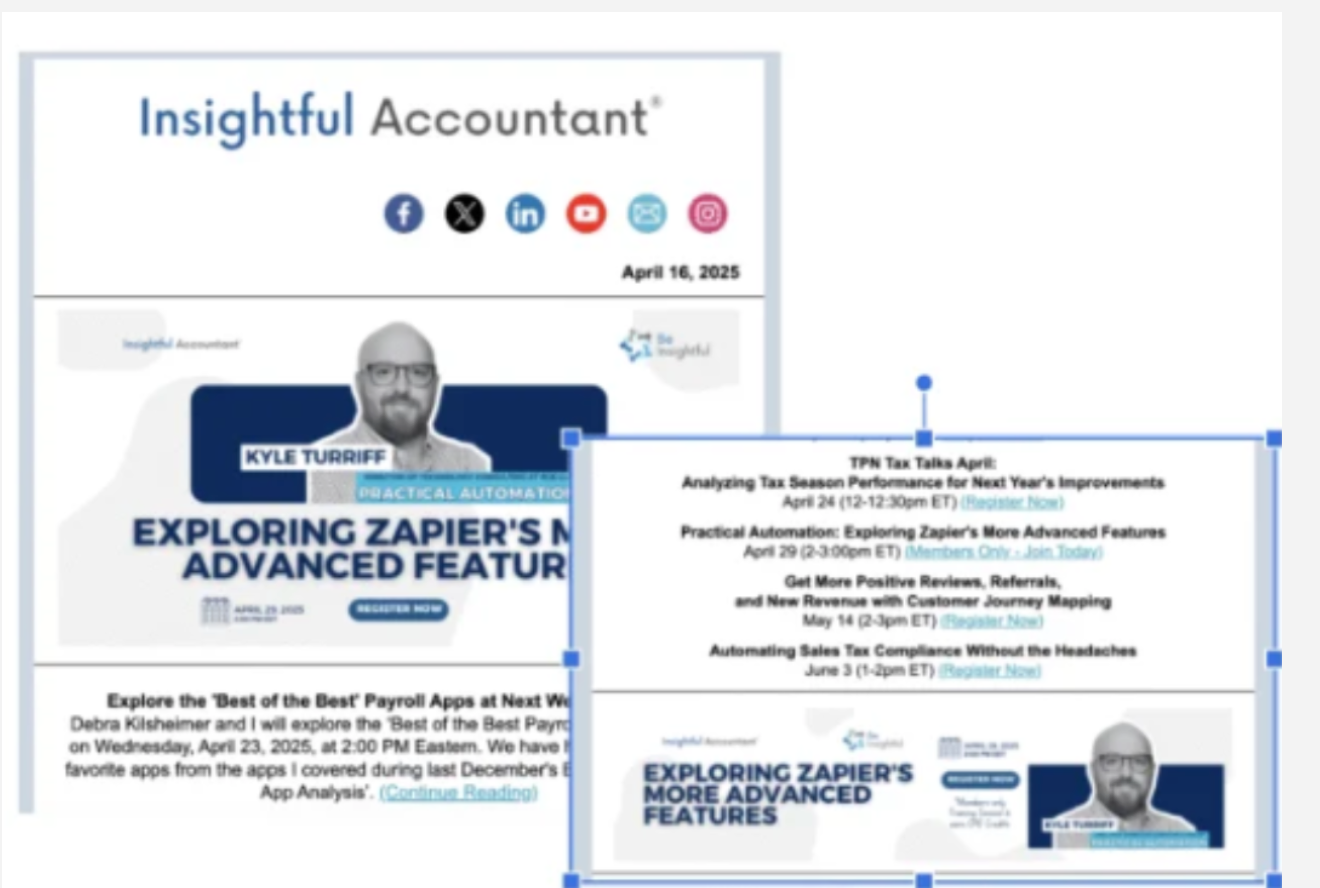
Publishers are also creating a few premium ads that can be limited and sell out. One example is Insightful Accountant, an 11,000-subscriber daily trade newsletter, which used to sell exclusive sends, but after noticing an increase in opt-outs, switched to selling one advertiser on each of the daily newsletters. The ad positioning is huge, but unlike exclusive sends, it does not add to the already daily frequency.
Publisher Gary DeHart calls it a Newsletter Takeover — a top banner, about 100 words of copy, and a bottom banner, all wrapped around that day’s editorial rather than competing with it.
Tuesday–Thursday runs $3,500/day.
Monday and Friday, the higher-subscriber days, run $5,000/day.
Of roughly 250 weekday takeover slots a year, about 100 sell to 55 advertisers, contributing an estimated $350,000+ in annual revenue.
“You have to protect the list and protect the product,” he says. “The takeover gave us a way to grow without burning out the audience.”
After selling out of the takeovers, he has since added a second ad position.
3. Price to incentivise faster purchases
Podnews.net, the podcast-industry daily founded by James Cridland, caps its classified ads at five per newsletter.
The first slot is the cheapest, at $29; each one after climbs to $60, then $90, and up, creating FOMO out of the price ladder alone.

The monthly title sponsor gets the top position and their name in the subject line to all 32,400+ subscribers, whether the email is opened or not; a position sold one month at a time.

4. Limit everything, including ads on the website and print
 One of the biggest proponents of limiting inventory is Mike Dragosavich, CEO of Spotlight Media Magazines and National Niche Media Publisher of the Year. He treats exclusivity as a rule for every product Spotlight sells, including the website.
Exclusivity could mean a 100% audience share of a key banner ad, or industry exclusivity within the magazine.
It does not have to be overly broad; if the category is finance, for example, publishers can limit the inventory to one commercial bank, one consumer bank, one mortgage broker, and so on.
On the site, that means capping digital ad slots and selling annual contracts.
“We have seven digital ads. Each one includes industry exclusivity and has a one-year commitment. Their value is that no other banks are in it. You won’t have to rebook them for another 12 months,” Dragosavich says.
Even programmatic campaigns get the same treatment: The programmatic buy for the wealthiest people in the market might be capped at five of four different types of banks.
5. Create urgency with deadlines
The deadline can matter as much as the cap: “We can say that if you don’t buy it in a couple of days, we will sell it to X… 99% of the time, it just works.”
This also cuts the sales cycle down, not just the price: “We don’t want to meet with them 40 times to get a $7,000 deal.”
“This fundamentally changes the sales dynamics from the model of unlimited inventory, when the publisher can always add another page,” he says.
6. Build pay-to-play products around exclusivity
In addition to selling the covers or page 3, annual Faces magazines are built around the concept of pay-to-play and exclusivity.
Spotlight Media’s “Faces” franchise, an annual coffee-table magazine, has categories like “Faces of Dining,” sells one sponsorship per sub-category, with 50 categories in all, listed alphabetically so no one can buy their way into a premium position.
That single restriction creates the urgency: first-come gets the category, and every category sells only once, and there are only 50 available industries.
Pricing is straightforward and full-page only: one page at $3,885, two pages at $4,188, four pages at $6,384, with archival plaques as a $219 add-on, for an estimated $200,000+ in annual revenues.
7. Add value that makes FOMO exciting
Limiting inventory works best when combined with exciting products
The key benefits in the Faces media kit include:
* A professional photo session with usage rights
* Advertisers get a full year of coffee-table visibility, 30,000 magazines distributed to 25,000 high-income households and 1,500 businesses.
• An “Official Face of [category]” badge for their own site and window decals.
For publishers who don’t have a flagship annual product yet, look at what content and advertisers are in the network for an upsell, and ask whether locking each category to one advertiser, plus a badge they can show off, would make it sell itself.
One publisher told us they did not even use a sales flyer for these products; the salesperson just used a call and/or email with the pitch, “Because of our relationship, I wanted to offer it to you before anyone else.” They closed deals on the phone without a media kit.
8. Don’t forget to apply FOMO to events
Events are great for FOMO because anything can be sponsored individually by one advertiser who gets the lanyard or the happy hour.
However, there are other ways to shorten the sales cycle and create FOMO: One publisher limited the number of booths sold to the same number they sold the previous year. The psychology still worked to get orders faster.
In summary: Underneath all these limited inventory plays are the same mechanics:
* A hard cap: This could be one per day, one per category, five/ten/twenty per tier, but never open-ended.
* Industry exclusivity: No competing bank, mortgage broker, or advertiser in the same slot.
* A go-to-market strategy that makes the advertiser feel selected for the first chance to buy.
* A real deadline — buy in two days, or we’ll shop it around to someone else; claim the category first or lose it.
* Annual contracts with first right of refusal for the next year.
* An added value pay-off, such as a professional photo session, a window and website badge, a coffee-table magazine in elite locations
The Bottom Line: None of these publishers grew by adding more inventory. They just sold it out and sold it faster.
Build your own plan with our FOMO creation calculator.


