
The case of the missing emails


Are your email open rates over-inflated?
The dirty little secret of the ESP industry is that “Most email services are over-reporting,” said Patricia McGuiness, CEO of SBM Audience Development, at the 2023 Niche Media Conference, especially since Apple launched Mail Privacy Protection (MPP).
Email management is a core skill within the niche publishing industry and for its partners. It is part of the distribution system for content and packaged into advertising and content marketing. Reports delivered to advertisers use the metrics from the publisher’s ESP, so publishers may paint a rosy picture of audience engagement while the audience gradually diminishes.
So it is essential to understand whether the ESP reports are actually valid.
Just because the ESP shows how many emails were delivered and opened, “That number is irrelevant to how many are getting delivered to the inbox,” she said.
“It’s stunning; it still takes my breath away.”
The problem starts with the difference between “delivered” – i.e., what the ESP shows reached the recipients’ server – and “deliverable” – i.e., it reached the recipient’s inbox.
In between, several third parties interrupt the process, including Apple and IT managers at individual companies. When an advertiser leaves because of dropping results, a publisher may be the last one to know that the audience is shrinking.
Take the case of missing emails from one such program SBM ran, in which a publisher sold third-party leads, emails from people who clicked and filled out a form.
Sometime around August 2022, while opens and clicks remained at typical levels, form-fill leads started dropping. This was not especially unusual since the response to paid leads varies, moving up and down during seasonal trends. But this time declines through the holidays into spring. By March, leads were down by 75% and still declining.

Everything else looked normal.
McGuiness delved into the issue. She uses a robust Email Service Provider (ESP) that can provide better data than Mailchimp and advises publishers to do the same. MailChimp, she says, could never provide data support for the deeper level evaluation she needed, which she says all publishers should have access to today.
Keep in mind, too, that as the sender, the publisher’s score is affected by the overall score of the ESP.
However, when she looked at the relevant data on opens, clicks, and bounces hard and soft for the campaign, it showed that opens were average and clicks went up, from 1.5 to 5%, as form fills continued to drop.
Something else must be wrong.
She checked the sender’s email score on Validity to ensure the bots looking at her email would also score it as trusted rather than dangerous.
Validity even showed an excellent score of 99 out of 100, so that could not be the problem.
She also checked the send reputation measures for blocklists, complaints, and unknown users. All these scores were low, and there were zero spam traps, also called honey pots. These are set by a company IT professional who uses emails sent to an employee who has left the company as “bait” and then blocks all emails sent to that user.
Everything was looking good.
Finally, McGuiness attended a Validity webinar for more insights into the anomaly of perfect scores, normal opens, sky-rocketing clicks – and dropping form fills.
Apple’s MPP policy
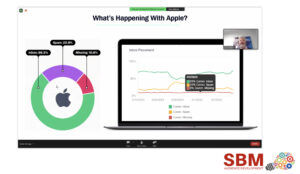
The first culprit to look at is Apple: its Mail Privacy Policy (MPP), in 2022, and the “open and screen” program artificially raised the open rate. This year, many companies have not yet caught on about open-rate inflation.
Apple sends 22.9% overall to spam (the purple area) and 66.3% to the inbox (green), with 10% of emails going missing (red), turned away by Apple for whatever reason, according to these slides in a webinar provided by Validity.
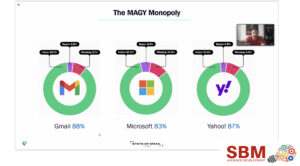
While Apple devices only account for 23% of opens, all email providers are affected by what Apple does, “if Outlook is on Apple or an Apple email product,” this slide shows that more than 40% of the opens across Gmail, Outlook, Yahoo and Apple mail are subject to Apple’s MPP.
Corporate MPP’s
The other culprit may be corporate MPPs designed by IT managers. They create a unique policy or algorithm that decides which mail to let through and which to block.
“Even if you have a sender score of 99%. The guys in IT can add filters,” McGuiness said. A clear sign that “something is up” is recipients who click on every link in a multi-link email.
However, there is no sure way to tell how many of the “opens” are turned away by MPP algorithms or which bot is randomly looking at landing pages, increasing the number of non-human clicks.
To solve the lead-generation problem, McGuiness recommends taking a different approach: Find the anomalies and delete or archive them, infilling the audiences with new approaches.
The new strategy versus the old
The old strategy at McGuiness’s company was to prioritize sending to opt-ins, prior customers first, and lists showing engagement, such as opens and clicks first.
Excluded were emails that were inactive for more than 180 days and opt-outs.
The new strategy changes it up. The new plan removes more categories and excludes the non-openers and opt-outs.
- Remove the soft bounces, Code “550” is the big one that says, the mail server blocked your content.
- Remove hard bounces, this is typically automatically done with many ESPs.
- Remove users that click ‘‘too many times.”
To identify the abnormal clickers, she scanned through the list of clickers to find and delete or suppress the anomalies – recipients who clicked multiple times on one link or on every link in a multi-link email.
Then she in-filled with a new list, in this case, about 10,000 names.
Even though these names were not all in the “top priority” – i.e., having opened and clicked to show engagement – results immediately improved. As this data chart shows, opens remained the same, but clicks returned to normal, from 5.35 to an expected average of 1 to 2%.
More importantly, lead generation began to rise again.

Lessons learned:
- Most email services are over-reporting, and several factors “are slowly eating into email deliverability” despite what ESPs report.
- More than 40% of emails may be opened by MPP, with a typical spam rate of 5% and a “known” missing rate of 10%. Assume only 85% of emails reach an inbox.
- Make sure to have a good ESP provider to be able to see the data on clicks and soft bounces and who is “over-clicking.” The best-case scenario is that they will work with you if you have a problem. Some, such as MailerLite will automatically exclude the Apple opens from the open rate on request.
- Monitor the data and look for anomalies, especially the “over-clickers.”
- If you have an anomaly, suppress all the soft bounces and “500 bounces” for 180 days and delete or archive the overtly “over-clickers.” They are not real clicks.
- Contact the IT manager from the entity supplying the over-clicks if necessary.
- Even opt-ins are missing, according to conference participants who “never got the email.” Again, contact IT managers for high-value customers and ask them to white list your content.
- Include “white list” buttons in as many places as possible.
- Use best practices for valuable and engaging content and a scoring service such as Validity.
- Have a plan to increase the entire list to overcome drop-offs from algorithm changes.
There are many ways to do this, including horse-trading, using Wiza, manually finding the targets via Google searches, or combining all of the above. You may find an extra target in an association membership list, use outsourcing to scrape contact emails, and WIZA to find the rest.
This may require developing personalized outreach to introduce the new contacts, including even connecting on LinkedIn first, but the extra work may be well worth keeping the audience solid and growing.
In short, today, senders have no way to tell why or how much of their content is delivered, so publishers need to be constantly list-building and incredibly diligent.
“It is not as black and white as it seems.”


