How to Vibe-code a B2B contact finding app

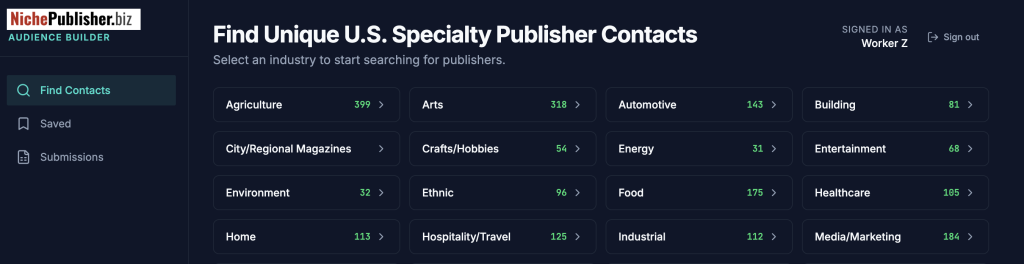
This use case shows how a publisher vibe-coded a B2B contact finder that delivers emails and related structured data at scale.

Use this to find advertiser contacts by industry or build an entire B2B audience. Included is the tech used, specific prompts used, an outline of the final workflow, adjustments needed, and results.

Challenge

When NichePublisher decided to cut its audience of 12,000 in half – to remove anyone who had not opened recently and structure the data for every contact- it also needed a plan to replenish the audience by reaching out to new specialty publishers.

The size of the specialty publisher marketplace is difficult to estimate, but the best guess is around 20,000.  So to arrive at a meaningful and dominant number of email subscribers – about 10,000 to 12,000 – meant finding  6,000 additional valid publishing contacts and structuring that data correctly.

After exhausting industry associations  – including all state and national publishers associations – finding good contacts at scale would require use of AI and other tools.

There were other challenges:

  • Automating a dupe check so new contacts did not repeat the current list. 
  • Data structure consistency. 
  • Mapping the search. With 30 categories to search, plus 120 possible sub-searches per category and five additional filters, the project required an organized search structure that a project manager could easily supervise.
  • Ensuring that new contacts had the right job title and that emails were valid.

The offshore contractor had only limited familiarity with AI and would not be able to use it on their own at scale, keeping the data structured correctly with the right job titles.

Strategy

The publisher decided to try building an automated tool on a no-code app builder, Replit.

The original goal was to create a platform that both a contractor could easily use without errors and where the admin would have an approval process.

The requirements, or prompt, given to Replit were as follows:

a. You are building a contact finder for [name of industry] platform. 

b. Any contractor should be able to log in with a password and perform searches by [list of] industry category and subcategory, and when finished,  click submit, which goes to the admin for approval.

c. The admin will be able to view any list submitted, approve, and download by date range.

d. Data found will be structured consistently to include [ industry category & subcategory, [job titles], [job title types’, geo-location [national, local, global], format, and LinkedIn URL when exported. Do not add data outside of this list given. 

e. Admin can add and subtract categories and subcategories
f. When the admin uploads any “do not duplicate” list to admin, the contact finder will not duplicate any [email] already imported.
g. Additional searches in the same industry category and subcategory will not duplicate data that has already been found.
i. Contacts without emails are auto-saved to a separate file for export later for further research, such as Rocket Reach.
j.The contractor can import/upload these enriched lists back into the app for admin approval.
k. If the enriched data is inconsistent with the structured data, the tool will automatically restructure it correctly.
l. Both the admin and the contractor can see pending and approved lists.
m. Both the PM and the contractor can see the total number of App-generated and Manually Researched contacts by date range as a base for pay for performance
n. The opt-out list, whenever input, will create a block on finding those contacts. 
This Replit app took about five hours to build and test.

Adjustments

The first human check is viewing the “pending” list: Does it look right? Do the job titles look right, and so on, asking Replit to adjust its search for anything that looks wrong.
After running the contacts through Neverbounce, with an 80% failure rate, the admin also had to ask Replit how to bring that percentage up to 60 to 80% valid.
Replit suggested searching more deeply, which took more time, and saved that instruction. This solved the problem.
Our recommendation is to test a list all the way through Neverbounce and a “Welcome letter” send in a forgiving platform not tied to the business name and emails to make sure the data is good before ramping up the program to its full contact-finding potential.
Finally, asked Replit to run the lists on a schedule – it can replace the contractor.
Since every search is new, we reran searches until no results surfaced.

Results

• Under the new workflow, the contractor found data for 10,000 high-level contacts over the course of two weeks.

• Cleaning in Neverbounce resulted in a 60% valid rate.

*Both Invalid emails from NeverBounce s and contacts without email at all were imported to Rocket Reach to find additional contacts, recovering about 10%.

*MailChimp under a different sender was used to test the  list with a “warm letter.” This removed unsubscribes and hard bounces before adding contacts to the real ESP.  The unsubscribe rate was about 1% on the first send, and under .3% afterwards.

•The process added about 6,000 valid new B2B  C-level contacts, bringing the list number up to 11,000. Current sends have a 20 to 35% open rate and 2 to 4% CTR.

*Eventually, the admin was able to ask Replit to run the searches in sequence, removing the need for the contractor.

*Paid tokenization credits to run the app came to about $300.


Related Articles

The Ultimate Guide to Selling Lead Magnet Advertising

Let’s get creative! We researched more than a hundred different lead magnet campaigns to find the best ideas that command top dollars from niche advertisers, and how they did it.

First, to define the terms: A lead magnet is simply gated information a publisher creates that is valuable enough to persuade the audience to leave their contact information.

Advertisers will invest 2 to 5x the cost of a major campaign and in some cases $30,000 to $50,000 – for publishers to create the content, host the lead capture page or system, and deliver the leads generated. They, too, are worried about Google Zero.

The Lead Magnet itself could be a white paper, e-book, video, podcast, or webinar — as long as there is a “hook” that attracts the audience to exchange their contact info for access.

Steal these ideas: Below is a list of the most powerful peer-shared ideas for lead magnet campaigns from case studies and research.

Newsletter Pricing: Some Publishers leave money on the table study shows

The single biggest opportunity we found in the 2026 Niche Newsletter Revenue Survey is simple: Many publishers underprice newsletter ads and sponsorships.

So how much should a B2B or B2C niche publisher charge based on list size and ad inventory? Is pricing different between B2B and B2C? And where, exactly, are publishers leaving money on the table?

Here are the metric you need to create pricing levels.

White paper: Recent research on the value of print advertising

How should niche media, dominated by magazine brands, talk to advertisers about the value of print? 

It’s a tricky issue. On the one hand, print sales continue to decline in the face of reduced advertiser demand. Media brokers place almost no value on profitable print advertising sales. This white paper shows all the research you need, with sources and links to use.

Never miss a trick! Get updates on new reports weekly